A Commander Is Appointed. A Leader Is Recognized
06.04.2026On April 23, I gave a lecture, "Crew Commander: From Appointment to Recognition," for staff of the Russian Ministry of Internal Affairs Directorate for the Omsk Region. The organizer was the Russian Society "Knowledge."
Why does this topic seem to me especially relevant for law enforcement? Because these people work where it's dangerous. Where material incentives have never matched the level of risk. And where formal service relations — "I'm the boss, you're the subordinate" — are not enough. There you need a team. A real one.
This kind of lecture isn't part of the cosmonaut training curriculum. But I'm convinced it's very important — both in the cosmonaut profession and everywhere people are required to deliver maximum effectiveness, maximum reliability, and the readiness to act in difficult conditions.
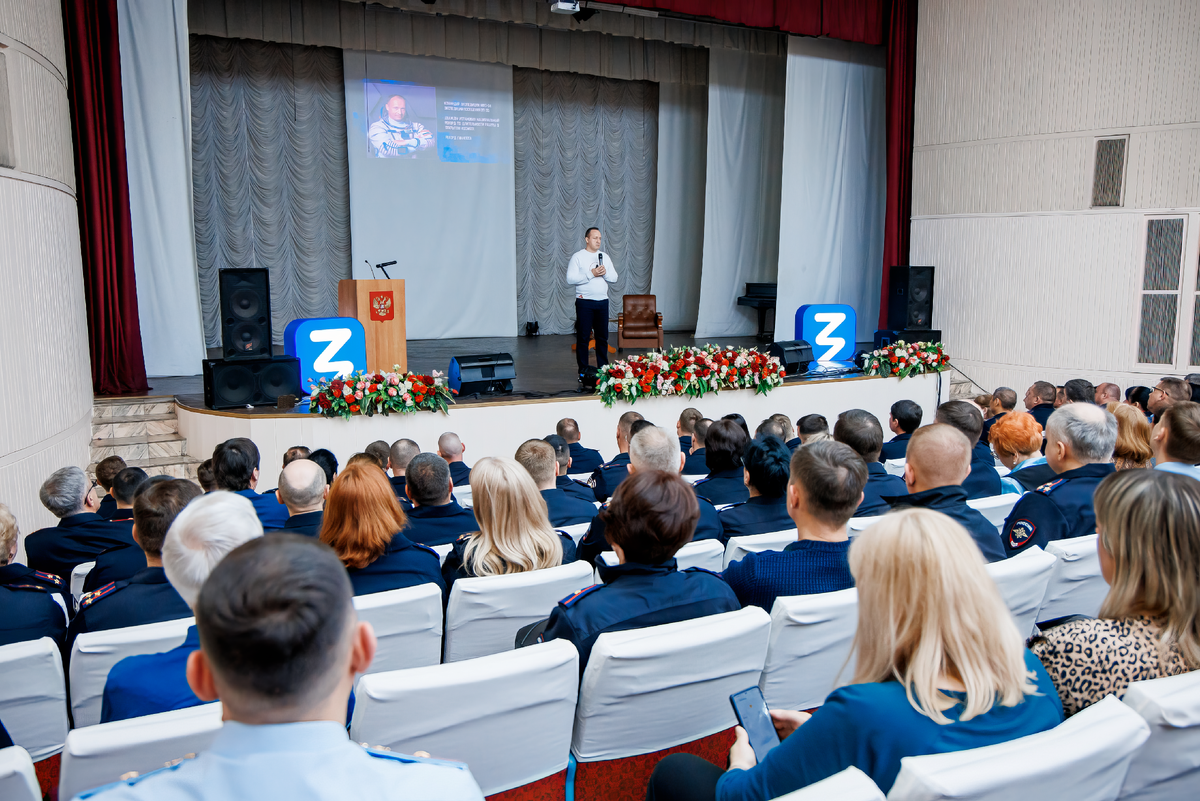
Not "do as I say" — "do as I do"
I was very lucky with my commander on my first flight. Pavel Vladimirovich Vinogradov, over time, became for me not merely an appointed commander but a real leader. And he remains so to this day. He didn't deliver speeches about meaning and values. But I saw it: he lives manned spaceflight. He rejoices in its victories. He's distressed when something goes wrong. He puts his strength into moving it forward. I didn't need to hear it from him — I read it from his behavior. And what I read coincided fully with what mattered to me myself.
That's what leadership is. Not "do as I say" — but "do as I do."
We all transmit the motives of our behavior, even when we don't put them into words — simply by carrying out our functions. But the people around us read these motives and try them on for themselves: is this close to me, or not? Does this match my inner settings, or not? And the degree of that match determines whether they will follow you in the critical moment — or not.
But you can't rely on that alone. In a small group — like a space crew — it may be enough to demonstrate your meanings and values through behavior. But when you work with a wider group of people, when you're actively recruiting people into a team — what comes to the front is precisely articulating, declaring: what matters in this team, by what principles it operates. So that a person, on entry, already receives a shared system of coordinates. Leonardo da Vinci divided people into three types: those who see; those who see when shown; and those who do not see. In a large team, the second group is the majority. And what's even more important — people must see complete consistency between what you declare and how you act. Any gap between word and deed destroys trust instantly.
"We make rockets"
There's a well-known story about a cleaning lady at Korolev's design bureau.
When she was asked what she did, she answered: "We make rockets." Not "I mop the floors" — "we make rockets."
Seems like just a nice story. But if you think about it: all spacecraft are assembled in clean rooms, where every speck of dust counts. Her mop, in the most literal sense, affected the final result. And she understood that.
A team begins at the moment when the shared meaning of the work becomes personal for each member. When everyone, from the chief designer to the cleaning lady, feels that their contribution is part of the common cause. This doesn't happen on its own. This is a leader's task.
Why this becomes a question of life and death
Each of us — like a unique set of chromosomes — has our own set of inner reference points. Some answer the question "why am I doing this" — let's call them meanings. Others answer the question "how am I doing this": what I consider acceptable and what I do not, what is right for me and what is unacceptable. These are values. Each person has their own, arranged in their own order of priority. For one person, honesty is a ten out of ten. For another, a five.
While everything is running normally, this difference is invisible. Everyone works, everything's fine. But the harder the situation, the more the result depends on how closely the inner reference points of the people on the team match. Not just intersect — but match in depth: how equally important the same things are to each person.
Imagine that two people both have honesty among their priorities. But for one, it's a ten — absolute, no compromises. And for the other, a five: important, but movable. While everything is calm, they work together excellently. But in the moment when a hard decision must be made, that gap will become a crack. And the higher the stakes, the wider that crack.
That's the difference between a tight-knit team and just a collective. Not that everyone has identical values — we are too different for that. But that the key ones overlap deeply. If the overlap is 50%, the team will fall apart on a task of medium difficulty. If 90%, it will go far further. For those who serve in law enforcement, this question is not theory. It is the question of whether a person will follow you when it gets dangerous.
A question I didn't expect
At the end of the lecture, one of the staff members asked a question I had heard for the first time.
He quoted Arthur C. Clarke: "Two possibilities exist: either we are alone in the Universe, or we are not. Both are equally terrifying."
Why it's frightening if we are alone is clear. But why is it frightening if we are not? There is the so-called dark forest theory: the Universe is a forest full of hunters. Every civilization hides and stays silent, because any other civilization is a potential threat. A more advanced one may treat a less advanced one the way humans have historically treated each other: colonize, subjugate, destroy. We ourselves are, in fact, a living example of how civilization treats those who are weaker.
I answered that I understood Clarke's position, but I disagreed with it. It doesn't frighten me if we are not alone. To me, that seems wonderful.
Half a century ago, Isaac Asimov said: "The saddest aspect of life right now is that science gathers knowledge faster than society gathers wisdom."
Today we are precisely at this point. Technology is growing exponentially. Every action of ours — at the level of states, organizations, even individuals — has ever more serious consequences. And if we keep the vector of "live by the right of the strongest," our growing technological power will sooner or later turn against us.
In mathematics there is the concept of an extremum — a point where a function changes direction sharply. The crisis of technological singularity could become such an extremum for our civilization. Either we reset to zero — or we transform qualitatively. And here's why the second option is real: the technologies emerging today — artificial intelligence, quantum computing, fusion energy, biotechnology — when applied wisely and with judgment, are capable of changing life so deeply that we cannot even imagine what tomorrow will look like. Unlimited clean energy, victory over disease, the exploration of other planets — all this is ceasing to be science fiction. But only on one condition: if the civilization learns not to destroy itself with what it creates.
So here is why we should not fear other civilizations. A civilization capable of reaching us reached this level only because it passed its own extremum — balanced strength and wisdom. Without that balance, it would have destroyed itself long before learning to travel between worlds. More than that: such a civilization would never invade. It understands perfectly that we ourselves need to pass through our crisis and grow. Only after that is contact possible — between equals.
And this is the very same thought we started with. Now is exactly the time for us — leaders, managers, each of us — to think about meaning. About what moves us. Technological power makes the consequences of every step we take more and more weighty. It's time to look at the civilization of planet Earth as a single crew. With shared meanings. With shared values. And the principle here is the same: not "do as I say" — but "do as I do."
Feedback from the head of the regional branch of the "Knowledge" society: "He skillfully connected his professional path with the topics of leadership and team building. It was especially gratifying that the talk contained no self-promotion. We will recommend it to other regions."
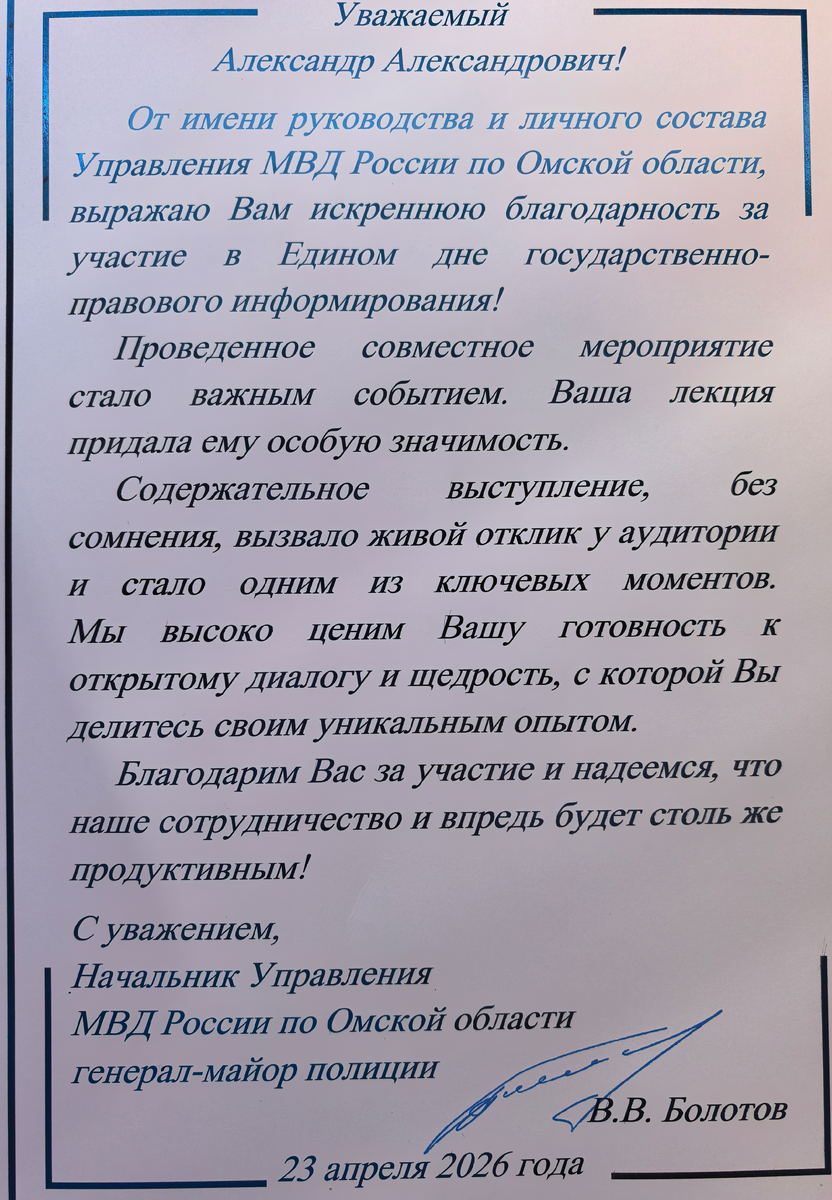
I thank the Russian Society "Knowledge" for the chance to share these reflections with colleagues from law enforcement.
Hello! I'm cosmonaut Alexander Misurkin. My AI assistants Luke Vestin and "19-57" will answer your questions about space exploration and my experience.
To chat with Luke – simply type your question in the text field. If you're looking for space-related information from online sources, type "19-57, find information about ..." (it may take a moment – our robot is very thorough when searching the web).
Enjoy the conversation!