Outstanding Women in Space
24.04.2025Women's Names in the History of Cosmonautics
Space exploration is one of the greatest achievements of mankind in the 20th century, and this area continues to develop dynamically in the 21st century. In the history of flights, a special place is occupied by outstanding female cosmonauts and astronauts, whose professional achievements and scientific contributions have become an important part of the development of near-earth orbit. As of today, more than seventy women from different countries have been in near-earth orbit: they conduct complex scientific experiments, go on spacewalks, and control spacecraft and orbital stations.
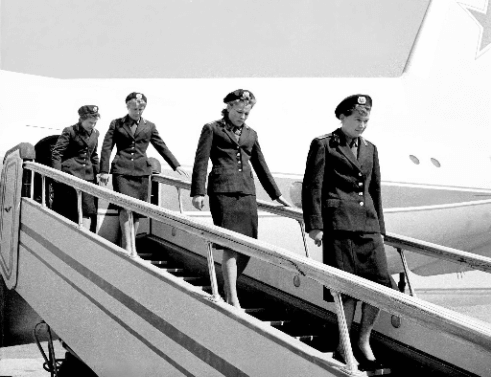
V. Tereshkova, Zh. Yorkina, V. Ponomareva, I. Solovyova. Archive: Moscow Museum of Cosmonautics
As part of the “Space Calling” project, I present to you the most significant achievements of women in cosmonautics — from Valentina Tereshkova’s first flight to modern expeditions.
Valentina Tereshkova: the First Woman in Space
The history of women in space begins in December 1961, when the Presidium of the Central Committee of the CPSU made a historic decision to recruit five women to the cosmonaut corps. On March 12, 1962, Tatyana Kuznetsova, Irina Solovyova, and Valentina Tereshkova were enrolled, and on April 3 of the same year, Zhanna Yorkina and Valentina Ponomareva joined them. They all immediately began general space training.
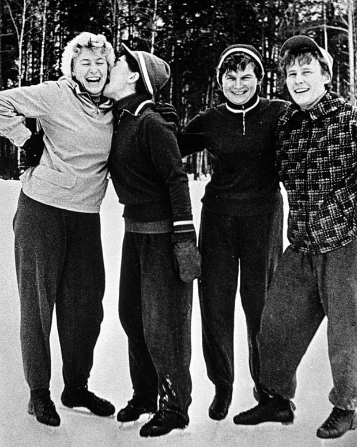
Test cosmonauts of the first female group of the cosmonaut corps of the Cosmonaut Training Center (from left to right): Tatyana Pitskhelauri (Kuznetsova), Irina Solovyova, Valentina Tereshkova and Valentina Ponomareva
The choice of the first woman to fly into space was the result of careful analysis. Here is what General Nikolay Kamanin wrote about the candidates: “Any of the cosmonauts can fly on the Vostok spacecraft... Of the four, only Tereshkova does not have a higher education... Ponomareva has a more thorough theoretical background and is more capable than others, she grasps everything on the fly, but her behavior needs serious correction... Solovyova, according to all objective data, is the most physically and morally resilient, but she is somewhat withdrawn and not active enough in public work. Tereshkova is an active social activist, capable of performing well, and enjoys great authority among everyone who knows her... Tereshkova should be the first to go on a space flight, and Solovyova could be her backup.”
On June 16, 1963, Valentina Tereshkova became the world's first female cosmonaut, flying on the Vostok 6 spacecraft. She spent almost three days in space, making 48 orbits around the Earth.
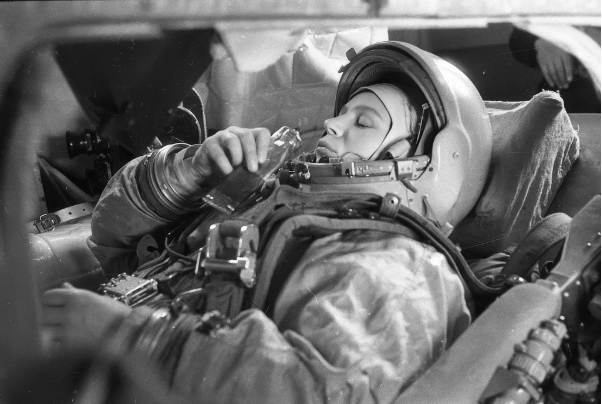
Archive: Moscow Museum of Cosmonautics
Tereshkova's flight was fraught with certain difficulties. On the second day, she experienced physical discomfort: aching pain in her right shin, pressure from the helmet on her shoulder, itching and pain under the sensor on her head. There were also problems with manually orienting the ship before landing, although Valentina eventually managed this task. She received minor injuries during the landing — a broken nose and a black eye — but overall, the landing was successful.
Svetlana Savitskaya: the First Woman to Go into Outer Space
Twenty years after Tereshkova's flight, on August 19, 1982, another Soviet woman, Svetlana Savitskaya, went into space. She became the second female cosmonaut in history and the first to make two space flights. Even before her space career, Savitskaya was known as an outstanding test pilot who set several world aviation records.
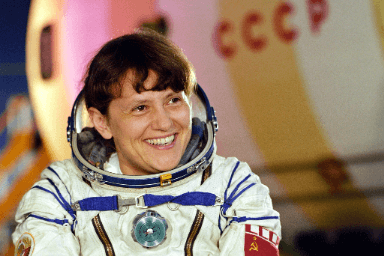
She gained real fame with her second flight into space in July 1984, when she became the first woman in history to go into outer space. The spacewalk lasted 3 hours and 35 minutes and had great practical significance: Savitskaya, together with cosmonaut Vladimir Dzhanibekov, tested a universal hand tool for welding, cutting and soldering metals in the vacuum of space.
During her flights, Savitskaya conducted numerous scientific experiments related to the study of the effects of space flight on the human body, testing new technologies for working in outer space, and other research.
Elena Kondakova: the First Woman to Spend a Long Time in Orbit
The next important stage in the history of women's cosmonautics is a long stay in orbit. The pioneer here was Elena Kondakova, who, on October 4, 1994, went to the Mir orbital station as part of the 17th expedition. Her flight lasted 169 days and 5 hours and became the first long-term flight of a female cosmonaut.
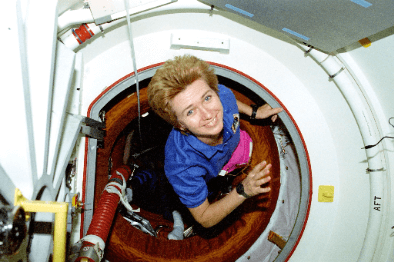
On board the Mir station, Kondakova carried out an extensive program of scientific research, including biological, medical and technical experiments. Her work made an important contribution to understanding how female body adapts to prolonged exposure to weightlessness, which is critical for planning future long-term missions, including flights to Mars.
Kondakova also made history as the first Russian woman to fly on an American Shuttle. In May 1997, she went into space aboard Atlantis (STS-84), which became a symbol of international cooperation in space in the post-Soviet period.
Elena Serova: the First Russian Woman at the International Space Station
After a 17-year break in the flights of Russian female cosmonauts, Elena Serova was sent to the International Space Station on September 25, 2014. She became the first Russian woman to visit the ISS and the fourth female cosmonaut in Russian history.
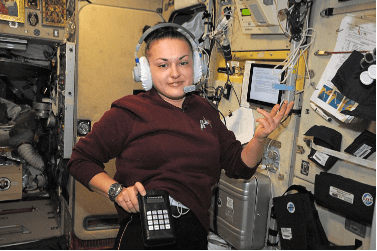
During her 167-day stay in orbit, Serova completed numerous technical and scientific tasks, including experiments to study the Earth's atmosphere, observation of plants in zero gravity, medical and biological research. She was also actively involved in educational activities, conducting lessons from space for Russian schoolchildren.
After returning to Earth, Elena Serova continued her career in politics, becoming a deputy of the State Duma.
Yulia Peresild: the First Actress to Star in Space
A new chapter in the history of women in space opened on October 5, 2021, when actress Yulia Peresild, together with director Klim Shipenko, went to the ISS to make the movie “Challenge”. This project became the world's first experience of creating a feature film in real space flight conditions.
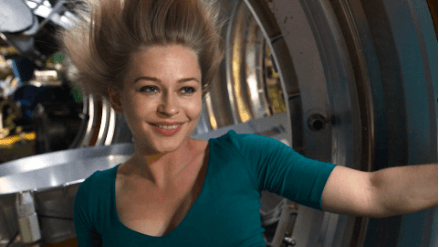
The crew's training took only three months, which by itself was a unique experiment. Despite the short training, Yulia successfully adapted to the conditions of weightlessness and coped with all the tasks of the 12-day expedition.
Filming in space presented a number of technical and organizational challenges: limited space, adaptation to weightlessness, tight deadlines. However, the result was unique and highly realistic footage that accurately conveyed both the interior of the station and the space views beyond it.
Judging by the reviews from various audiences, the film successfully achieved its main goal: to increase the popularity of cosmonautics in society.
Anna Kikina: the Space Path of a Modern Russian Woman
Anna Kikina was the only woman in the Roscosmos cosmonaut corps for a long time. Her path to the profession was unusual — before joining the cosmonaut field, she worked as a radio host. She also has a certificate of rescuer of the Ministry of Emergency Situations.
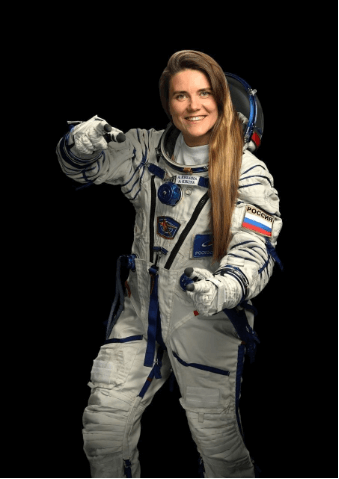
On October 5, 2022, Kikina flew to the ISS as part of the SpaceX Crew-5 crew, becoming the first Russian woman to go into orbit on an American spacecraft as part of the cross-flight program.
During her 157-day stay in orbit, Anna conducted more than fifty scientific experiments, including research in biology, physiology, materials science and other sciences. She was actively involved in educational activities, conducting virtual tours of the station and talking about life and work in space through social networks.
Anna Kikina's experience demonstrates new opportunities for international cooperation in space and confirms the high level of professional training of Russian cosmonauts capable of working on various spacecraft.
It should be noted that in the latest recruitment of Roscosmos, Anastasia Burchuladze was accepted into the team, becoming a new representative of women in Russian cosmonautics. This indicates the expansion of women's participation in space exploration in our country.
International Experience: Female Astronauts from Other Countries
Women's contribution to space exploration is not limited to the achievements of Russian cosmonauts. Over the past decades, representatives of many countries have left their mark in the history of cosmonautics.
The first American woman in space was Sally Ride, who flew on the shuttle Challenger in June 1983. She opened the way to space for many American women, and their number in the NASA astronaut corps has increased every year.
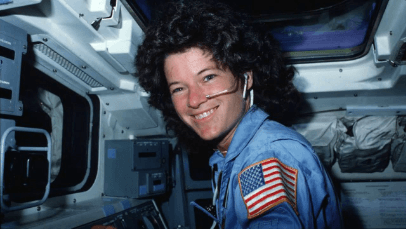
Astronaut Sally Ride
Of particular note is Peggy Whitson, the all-time record holder for women in total time in space (675 days over four flights). Notably, Whitson served as NASA's astronaut commander and flew as a commercial astronaut for Axiom Space in 2024, paving the way for a new era of commercial spaceflight. As of today, she has already completed the second flight to space as part of the commercial crew: Ax-4, launched on June 25, 2025, and landed July 15, 2025.
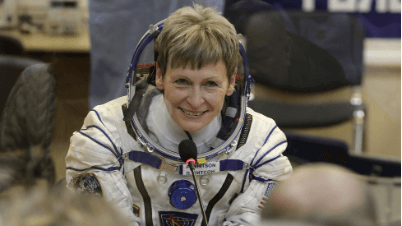
Astronaut Peggy Whitson
An important milestone was the participation of women in space expeditions as crew commanders. Eileen Collins and Pamela Melroy made history as Shuttle commanders who carried out several successful flights. Their leadership proved that women were capable of effectively leading the most complex space operations.
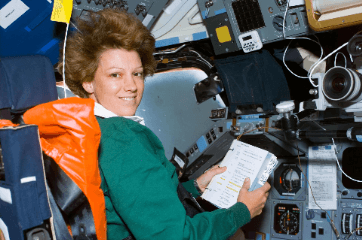
Astronaut Eileen Collins
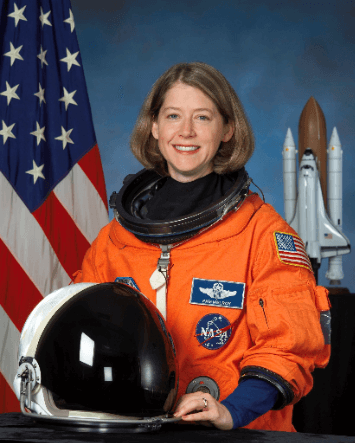
Astronaut Pamela Melroy
The history of cosmonautics will also remember the first all-female spacewalk, carried out by Americans Christina Koch and Jessica Meir on October 18, 2019. It lasted 7 hours and 17 minutes and included replacing a failed battery charge-discharge controller on the outer surface of the ISS.
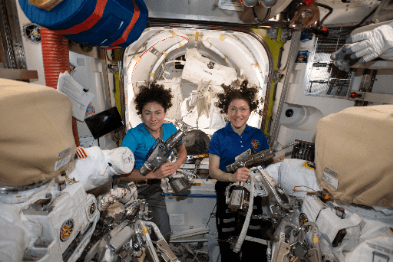
Astronauts Christina Koch and Jessica Meir prepare for spacewalk
The record holder for the total duration of spacewalks among women is American astronaut Sunita Williams: nine spacewalks with a total duration of 62 hours and 6 minutes.
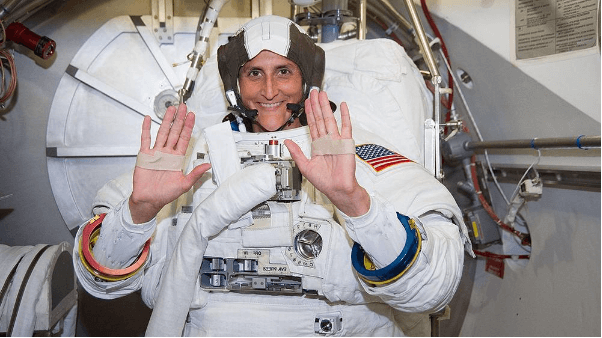
Astronaut Sunita Williams
Other notable “firsts” worth mentioning include Claudie Haigneré, the first French woman in space; Samantha Cristoforetti, the first Italian; Lee So-yeon, the first South Korean; and Helen Sharman, the first British woman. In 2025, Rabea Rogge joined that list as the first German woman to fly in polar orbit and become the first foreign female pilot on an American spacecraft.
Anousheh Ansari made a special contribution to the democratization of space travels when she became the first female space tourist in 2006. She paved the way for greater non-professional participation in spaceflight, which is becoming an increasingly common practice today.
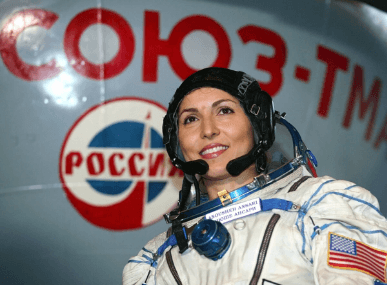
Space flight participant Anousheh Ansari
Another important step was the spacewalk by Sarah Gillis, an engineer at SpaceX, on the private Polaris Dawn mission in 2024. At 30, she became the youngest woman to walk in space and the first non-professional astronaut to do so.
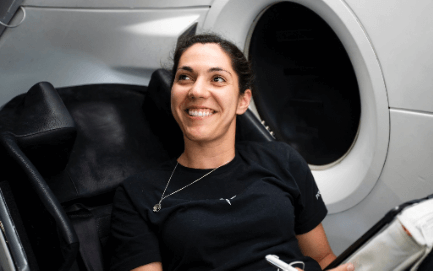
Commercial astronaut Sarah Gillies
April 14, 2025 marked a significant event: Blue Origin made its 31st suborbital flight, launching its New Shepard spacecraft to an altitude of 106 kilometers. This flight was historic, because for the first time in 62 years, after the solo triumph of Valentina Tereshkova, an all-female crew went to the “edge of space”. The inspiration behind the idea was Lauren Sanchez, a well-known American journalist. Along with her, outstanding women from various fields boarded New Shepard: American pop star Katy Perry, CBS morning show host Gayle King, talented movie producer Kerrianne Flynn and, of course, scientists, without whom space exploration would be impossible: Aisha Bowe, a rocket scientist, and Amanda Nguyen, an expert in bioastronautics and astrophysics, both have extensive experience at NASA.
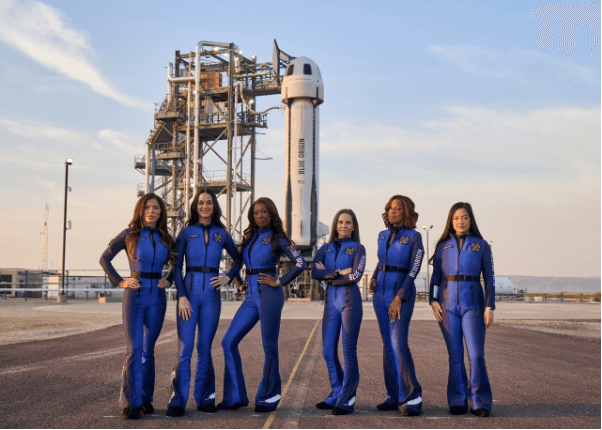
From left to right: Lauren Sanchez, Katy Perry, Aisha Bowe, Kerianne Flynn, Gayle King and Amanda Nguyen
New Horizons of Cosmonautics
The history of space exploration clearly demonstrates the evolution of ideas about the accessibility of this activity. Initially, dangerous professions associated with high risk were traditionally considered the prerogative of men — be it pilots, long-distance sailors or explorers of new territories. Cosmonautics was no exception: the first teams were formed primarily from military pilots and test pilots.
Over time, women have increasingly shown themselves to be active in many professions that require high professionalism and a willingness to take risks. In cosmonautics, this path began with the experimental flight of Valentina Tereshkova, which proved the fundamental possibility of women working in space. Then came Svetlana Savitskaya's spacewalk, Elena Kondakova's long-duration orbital missions, and Eileen Collins and Pamela Melroy's command of shuttle crews. Women cosmonauts have come a long way in their careers.
It is especially significant that today, even women who are not professional astronauts, like Sarah Gillies during the Polaris Dawn private mission, are going into outer space. This convincingly shows that humanity has opened a new page in the history of space exploration. The time has come for the active development of private astronautics, which means an acceleration of the pace of exploration of near-earth space by our civilization. Development is exponential, and very soon space will become closer to everyone who reads these lines.
Of course, the professional contribution of female cosmonauts and astronauts to the development of manned space flights should be noted with great respect. Their achievements are not just important pages in the history of cosmonautics, but also a significant step towards making space truly accessible to all of humanity. It is also important to remember the women astronauts who gave their lives in the name of space exploration: Christa McAuliffe and Judith Resnik, who died in the Challenger shuttle disaster in 1986, and Laurel Clark and Kalpana Chawla, who died on Columbia in 2003.
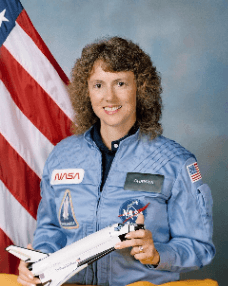
Astronaut-teacher Christa McAuliffe (Teacher in Space program)
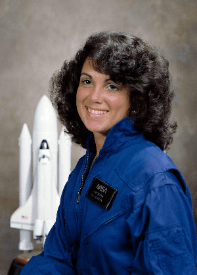
Astronaut Judith Resnik
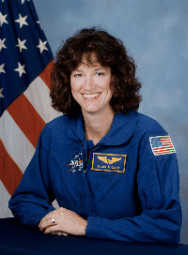
Astronaut Laurel Clark
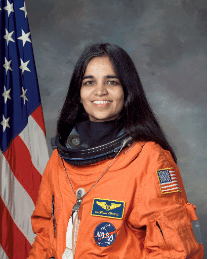
Astronaut Kalpana Chawla
These wonderful, selfless women remained devoted to science and space exploration until the end of their lives. Blessed memory to them.
Pilot-Cosmonaut, Hero of Russia
Alexander Misurkin
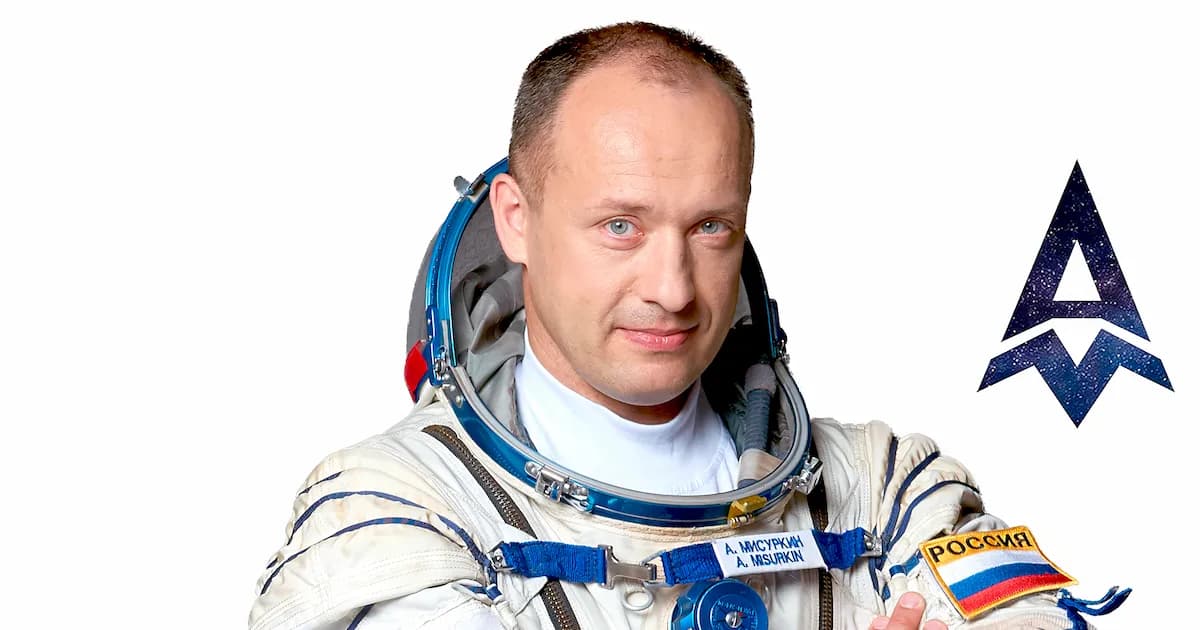
Hello! I'm cosmonaut Alexander Misurkin. My AI assistants Luke Vestin and "19-57" will answer your questions about space exploration and my experience.
To chat with Luke – simply type your question in the text field. If you're looking for space-related information from online sources, type "19-57, find information about ..." (it may take a moment – our robot is very thorough when searching the web).
Enjoy the conversation!