Space Communications: Modern Technologies and the Future of Communications
08.05.2025Dear friends! Our project “Space Calling” is almost over. It consists of 16 articles and 6 episodes of documentary about various aspects of cosmonautics. In this final article, I will talk about space communication technologies, their development and prospects, and share my personal experience of using these systems during space flights.
How Space Communications Work
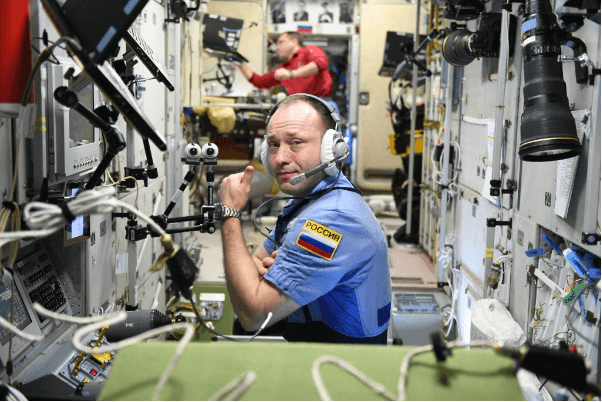
Imagine: you are a few hundred kilometers from Earth on the International Space Station. Your home, family, and everyday life are all down there, on the blue planet. What connects you to Earth, other than the invisible force of gravity? Right: the space communication system.
One day during my first flight, there was a failure in the operation of the relay satellites and the station was plunged into silence for a few hours. Suddenly, instead of constant negotiations on various channels, I began to hear sounds that I had never noticed before: the sounds of thermal deformations of the station's skin. At that moment, the four hundred kilometers that separated me from the surface of the Earth suddenly seemed like an infinitely long distance. I felt how important space communication is — not only as a technical necessity, but also as a psychological thread connecting us to home.
Space communications today are not only contacts between the Earth and spacecraft. It is a huge infrastructure that provides satellite television, mobile communications in remote regions, Internet on board aircraft and ships, precise navigation and many other services without which you can hardly imagine modern life. More than 30 petabytes of data passes through satellite channels every day, satellite communications industry is valued at hundreds of billions of dollars and continues to grow by 5–7% annually.
History of the Space Communications Development
First Steps and Achievements
The history of space communications started with the space era. The first artificial Earth satellite, launched in 1957, transmitted simple radio signals — the famous “beep-beep” that radio amateurs around the world could hear. It was the first example of one-way communication from space to Earth.
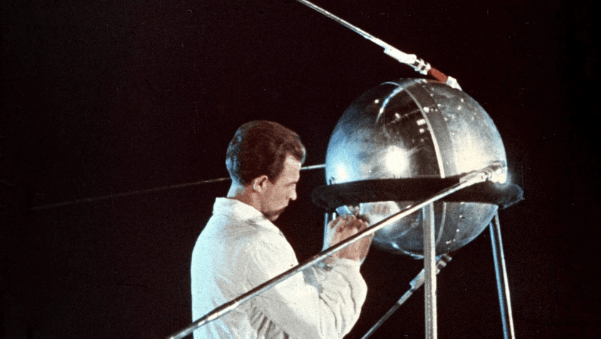
The first artificial satellite of the Earth, a still from a 1957 film
The true revolution happened in the early 1960s. In 1960, NASA launched the Echo 1 satellite, a huge metallized sphere 30 meters in diameter that simply reflected radio signals like a mirror. In 1962, Telstar 1 appeared — the first satellite with an active repeater that could receive a signal, amplify it and transmit it back. It was responsible for the first transatlantic television transmission between the USA and Europe.
The most important step was the creation of geostationary satellites, “hovering” over one point on Earth at an altitude of about 36,000 km. The first device of that kind was Syncom 3, launched in 1964. And in 1965, the first commercial geostationary communications satellite was launched — Intelsat 1 (Early Bird). This device could provide the operation of 240 telephone lines or one television channel.
In the USSR, the development of satellite communications followed a parallel course. In 1965, the Orbita system was created using Molniya satellites in highly elliptical orbits, which made it possible to provide communications to the northern regions of the country. In these locations, the use of geostationary satellites is inefficient because from polar latitudes, the line of sight to a geostationary satellite will be at the horizon, making signal reception difficult, especially in poor weather conditions.
Modern Technologies and Systems
Over the past decades, space communications have gone a long way. At the beginning of the space era there were single devices in orbit, and today the number of working satellites has exceeded 9000. A lot of them are intended to provide communications.
Global satellite communication systems include such well-known projects as Iridium (66 satellites in low orbit), Globalstar (48 satellites), Inmarsat (13 geostationary satellites). The Russian constellation is represented by Express and Yamal series, as well as the Luch system of relay satellites, including those providing communications with Soyuz spacecrafts.
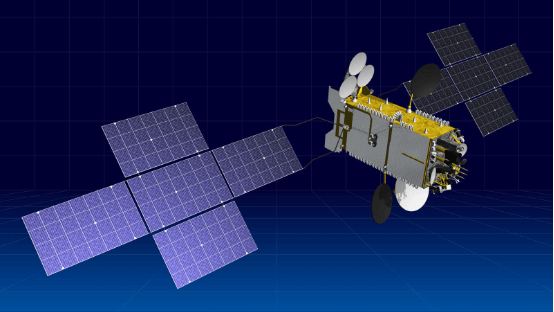
Express Series satellite
The industry has been revolutionized by new low-orbit constellations projects — Starlink by SpaceX (more than 5,000 satellites as of now) and OneWeb (about 600 satellites). These systems provide internet connection speeds of up to 150 Mbps with minimal signal latency, which makes them attractive even compared to terrestrial communication technologies. SpaceX plans to expand its constellation to 12,000 satellites, and eventually to 42,000.
Enormous progress has also been made in the field of deep space communications. NASA devices transmit data from other planets, and the New Horizons probe sent information from a distance of more than 5 billion kilometers. This technology requires the use of powerful ground stations with antennas up to 70 m in diameter, which are part of the Deep Space Network.
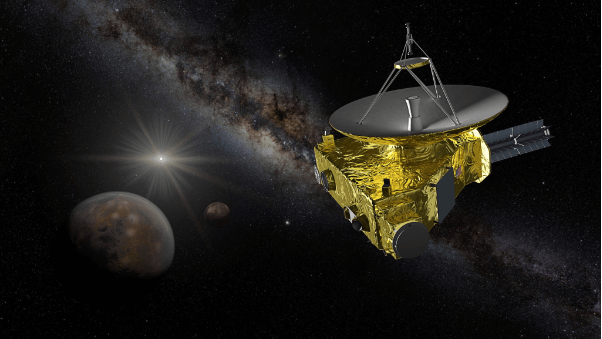
New Horizons Probe (NASA)
Technical Aspects of Space Communications
Space communications are an intricate technological complex, including both orbital and ground segments. Let's consider the main technologies that provide the possibility of communication through space.
Radio and Optical Communications
Traditionally, space communications are carried out using radio waves of various frequency ranges. Each has its own advantages and disadvantages. For example, the S-band (2–4 GHz) is often used for spacecraft command lines, while the Ka-band (26–40 GHz) is used for high-speed data transmission.
Fun fact: the Voyager 1 probe transmitter, operating at a distance of more than 23 billion kilometers from Earth, has a power of only 23 watts, like a small light bulb. Despite this, its signals are successfully received on Earth thanks to huge antennas with a diameter of 70 m and super-sensitive receivers cooled down to the temperature of liquid helium (about –269 °C).
However, the future of space communications probably lies in optical (laser) technologies. During my first flight to the ISS, we conducted an experiment on laser communications between the station and a ground receiver. The advantage of such communications is that it allows for the transmission of much larger amounts of data with less energy and using more compact equipment.
For example, the LLCD laser communications system on the LADEE lunar orbiter demonstrated a data rate of 622 Mbps over a distance of 400,000 km in 2013 — hundreds of times faster than conventional radio systems. And the modern LCRD system, launched by NASA in 2021, is capable of transmitting data at 1.2 Gbps.
Satellite Communication Systems
Satellite communication can be organized using satellites in various orbits.
- Geostationary orbit (GEO) — altitude of about 36,000 km. The satellite seems to “hover” over one point on the equator. The advantage is constant visibility from one point on Earth, the disadvantage is a large signal delay (more than 500 ms round trip) and a weak signal in the polar regions. Examples: Intelsat, Eutelsat, Russian Express.
- Medium Earth Orbit (MEO) — altitude of 8,000–20,000 km. A compromise between coverage and signal delay. Examples: GPS, GLONASS, Galileo navigation systems; O3b communication system.
- Low Earth Orbit (LEO) — altitude of 500–1500 km. Minimal signal latency, but requires a large number of satellites for constant coverage. Examples: Iridium, Starlink, OneWeb.
- Highly elliptical orbit (HEO) — apogee up to 40,000 km, perigee about 1000 km. Used to provide communications in polar regions. Examples: Russian Molniya System.
Each communications satellite is equipped with transponders — devices that receive a signal on one frequency, amplify it, and then transmit on another frequency. Modern satellites can have dozens of transponders and form up to 150–200 separate beams, providing flexible coverage and high throughput.
Problems and Challenges in Space Communications
Signal Delays and Attenuation
One of the fundamental problems of space communications is signal delay due to huge distances. Even at the speed of light (about 300,000 km/s), the signal from a geostationary satellite takes about 250 ms to reach Earth. For communication with Mars, the one-way delay is from 3 to 22 minutes, depending on the relative positions of the planets.
At the ISS, we constantly feel this delay when talking to Earth. It creates a characteristic rhythm of communication: phrase — pause — answer. One gets used to it over time, but it is not like a normal phone conversation.
Another problem is signal attenuation with distance. Signal strength decreases proportionally to the square of the distance. A good example: the 20-watt radio transmitter on the New Horizons probe at Pluto creates a signal on Earth of about 10–18 watts. It is so weak that huge antennas and ultra-sensitive receivers are required to detect it.
Limited Transmitter Power
Spacecraft have strict energy consumption limitations. Onboard systems are powered by solar panels or radioisotope generators, and the energy of such devices is not enough for powerful transmitters.
For instance, a typical satellite in geostationary orbit has solar panels with a total capacity of 15–20 kW, of which only a portion may be used for communications systems. And in deep space, where solar panels are inefficient, radioisotope thermoelectric generators (RTGs) with even less power are used.
To overcome these limitations, directional antennas, efficient modulation and signal coding methods, and optimized use of the frequency spectrum are used. But physical limitations remain an insurmountable barrier, especially for deep space communications.
Prospects and Future of Space Communications
New Technologies and Developments
The future of space communications is associated with several breakthrough areas.
- Massive low-orbit constellations. Projects like Starlink and OneWeb represent a new paradigm: instead of a few large satellites, thousands of small devices are used to cover the entire planet with a high-speed Internet network. Miniaturization of electronics and standardization (for example, the CubeSat format — cubic satellites with a 10 cm edge) make it possible to significantly reduce the cost of launching devices into orbit.
- Inter-satellite communication links. Modern satellites are equipped with laser terminals for direct communication with each other, which allows creating a full-fledged space network without the need for constant communication with ground stations. In the Starlink system, up to four laser terminals are installed on each satellite since 2022.
- Quantum communications. The Chinese satellite Micius (Mo-tzu) has already demonstrated the possibility of quantum key distribution over a distance of more than 1,200 km. This opens the way to the creation of absolutely hack-proof communication channels.
- Terahertz communication. Using the terahertz range (100–300 GHz) will potentially allow data transfer rates of several terabits per second to be achieved.
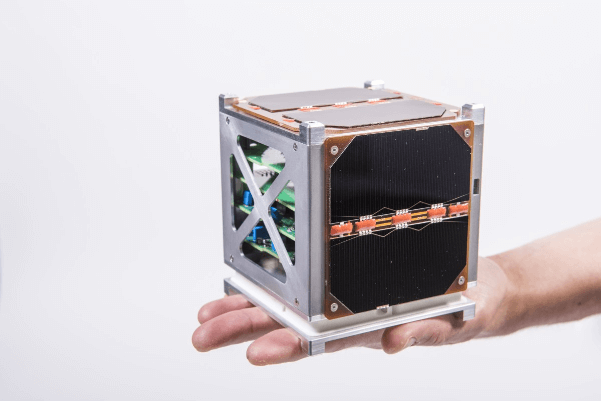
CubeSat series satellite
Global Projects and Initiatives
Among the largest projects in the field of space communications for the next decade, the following can be highlighted.
- Further development of SpaceX's Starlink system with plans to expand the constellation to 42,000 satellites.
- Amazon's Kuiper project with a planned constellation of 3,236 satellites to provide broadband internet access.
- The Chinese Guowang (SatNet) system with a planned constellation of 13,000 satellites.
- The Russian multi-satellite system Sfera, including communications and Earth remote sensing satellites.
- NASA and ESA projects to create communications infrastructure for future lunar missions.
Particular attention is being paid to the creation of communication systems for deep space as part of plans to explore the Moon and Mars. They will have to ensure reliable communication with crews and automatic devices at distances of millions kilometers.
The Space Debris Problem and Communication Satellites
The rapid growth of communications satellites, especially in low-orbit constellations, has exacerbated the problem of space debris. It is especially relevant for modern communication systems, since even a small piece of debris can disable a satellite due to the high relative collision speed (up to 10 km/s). Companies deploying new constellations are forced to develop systems for timely deorbiting of satellites after the end of their service life and to provide backup devices to replace those that fail.
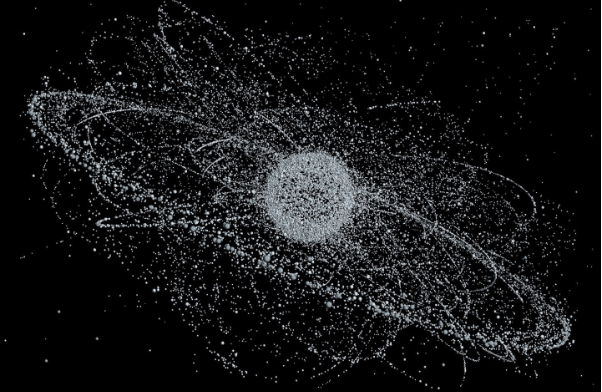
A map showing every known object in space around the Earth
Solving this problem requires international cooperation and a responsible attitude from all who take part in space activities. The new standards provide for mandatory disposal of spent satellites by deorbiting them and burning them up in the atmosphere or transferring them to a “burial orbit.”
Space communications have evolved from simple signals from the first satellite to complex global systems that transmit terabytes of information daily. Today, this technology has become an integral part of the global infrastructure that impacts the lives of billions of people.
The future of space communications is opening up new horizons — from global high-speed Internet to quantum communications and deep space communication systems. These technologies will not only provide us with faster access to information, but also become the basis for the next stage of human space expansion: exploration and development of the Moon, Mars and beyond.
While in orbit, I felt how important reliable communications are for people in space. It is not just a working tool, but also psychological support, a bridge to home.
The Space Calling project is coming to an end, but I believe that for many of you, the journey into the world of cosmonautics is just beginning.
Looking back at all 16 articles and 6 documentary episodes that we have produced, I hope that those who have followed our project from start to finish have been inspired by both an interest in space activities and an awareness of the responsibility that lies with us all. After all, space is not only exciting adventures and technological breakthroughs, but also a fragile matter that requires careful handling.
All the topics of the articles — from the selection to the cosmonaut corps to everyday life in orbit, from the history of the first satellites to the prospects of interplanetary travel — are united by the same important idea: the road to space is open to those who dream and are ready to work. And it doesn't matter whether you become a cosmonaut, an engineer, a scientist, or find your calling in a completely different field. The main thing is that the starry sky inspires you to new achievements.
Pilot-Cosmonaut, Hero of Russia
Alexander Misurkin
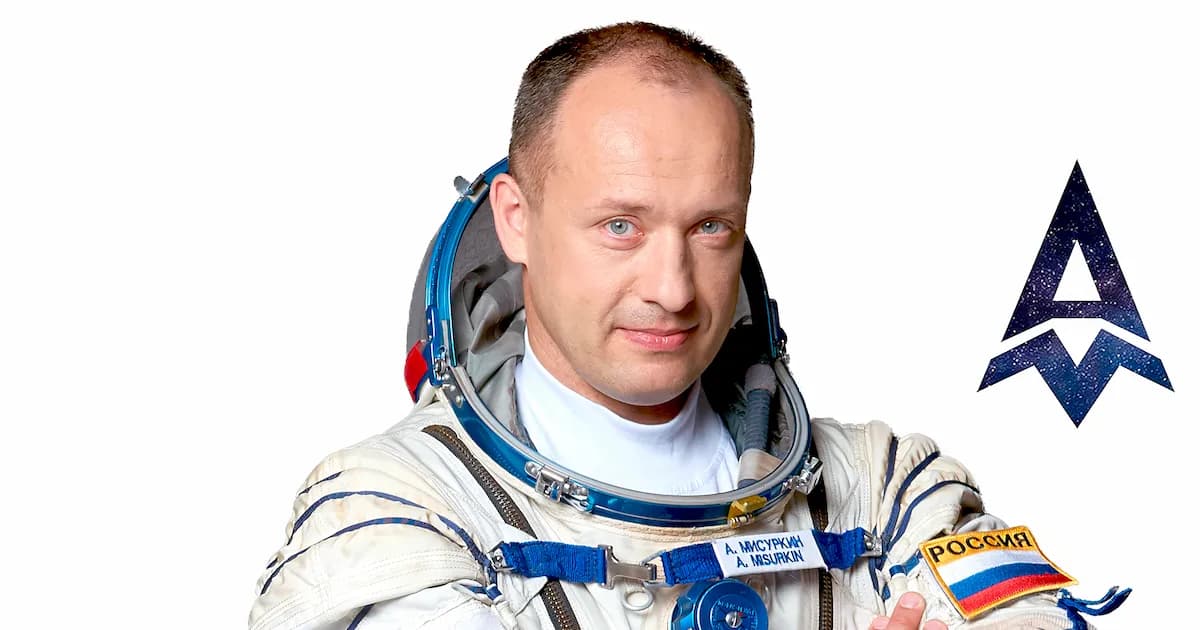
Hello! I'm cosmonaut Alexander Misurkin. My AI assistants Luke Vestin and "19-57" will answer your questions about space exploration and my experience.
To chat with Luke – simply type your question in the text field. If you're looking for space-related information from online sources, type "19-57, find information about ..." (it may take a moment – our robot is very thorough when searching the web).
Enjoy the conversation!