Top Books About Space: From Scientific Papers to Sci-Fi Novels
20.04.2025As part of the “Space Calling” project, we continue a series of publications about space and everything associated with it. Today, I will tell you about books that help you better understand space, its structure, and the place of humans in the Universe.
Why Read Books About Space
Space has fascinated humanity since ancient times. Observing the starry sky, we ask ourselves questions about our place in the Universe. When you see the Earth from space, the perspective changes, and a more holistic understanding appears of the fragility of our planet and the unity of all humanity.
The first thing expedition commander Chris Hadfield showed me after we arrived at the ISS in 2013 was, as expected, the personal protective equipment in case of an emergency. And the second thing he showed me was what the Earth looks like from Cupola... It was the only moment in my life when I unconsciously said out loud to myself: “I can’t believe I’m here...” Many times afterwards, when I flew to Cupola to contemplate our planet, I thought about how strangely all the necessary conditions for the origin of biological life came together at that point in the Universe where we know it. I am sure that reading popular science books can lead to the same fundamental questions of existence.
Good literature about space not only broadens one's horizons but also helps to form a “cosmic perspective” — a view of the Earth and humanity in the context of the infinite Universe. Interestingly, a 2019 University of California study found that reading non-fiction books about space increased teens' interest in science by 23%.
Popular Science Books About Space
“Cosmos” by Carl Sagan
In this book, Sagan talks not only about space, but also about how people have learned about it in historical perspective, how generally accepted beliefs have changed, how scientists have sometimes defended their beliefs at the cost of their lives, how brilliantly they made discoveries. What impressed me most was how the Greek scientist Eratosthenes came to the conclusion that the Earth is round and accurately calculated its size using just two sticks and a brilliant experiment, 2300 years ago!!!
“Cosmos” has been translated into 40 languages and has sold over five million copies, making it the best-selling popular science book about space in English. Sagan's distinctive style combines scientific precision with poetry and philosophical reflection, making his work unique.
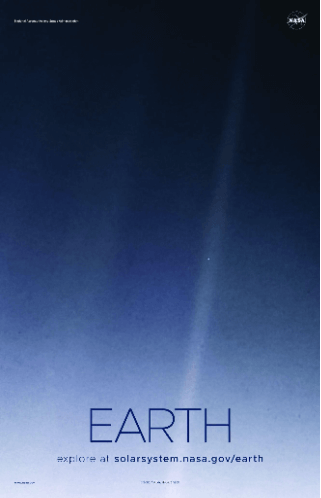
Sagan's famous quote about the “pale blue dot”, inspired by a photo of Earth from six billion kilometers away, is close to me, even though I did not see our planet as a grain of sand. But I felt its fragility and uniqueness, understood that it is a precious pearl of the Universe, the size of a grain of sand in an endless cosmic ocean.
And his phrase, “We are made of stardust,” became a true cultural phenomenon, inspiring many scientific and creative projects.
“A Brief History of Time” by Stephen Hawking
First published in 1988, this book set a Guinness record for the longest stay on the non-fiction bestseller list (237 weeks). Hawking succeeded in making complex cosmological concepts — quantum mechanics, relativity, the nature of black holes, and the origin of the universe — accessible to a wide audience.
Fun fact: Hawking was convinced by his editor that each formula in the book would halve the number of readers, so only one was included in the text — the famous E=mc². After the book was published, the number of students choosing astrophysics as a specialization increased by 40% in English-speaking countries.
“Einstein's Cosmos” by Michio Kaku
A work by modern theoretical physicist Michio Kaku, published in 2004, shows how Albert Einstein's ideas revolutionized our understanding of the universe and continue to influence modern science. The author uses analogies and thought experiments to explain concepts such as the curvature of space-time, gravitational waves, and the expansion of the universe.
Kaku not only explains classical theories, but also touches on modern concepts: dark matter, dark energy, multidimensional spaces, and string theory. He also connects abstract cosmological ideas with practical future technologies, such as interstellar travel and quantum teleportation.
Science Fiction About Space
“The Martian” by Andy Weir
Although this is a science fiction novel, it is perceived almost as reality. The events take place in the future, but nothing that would be fundamentally impossible. And in this context, the way the main character Mark Watney did not panic, but gathered his courage and solved problems one by one, is perceived as a real example of resilience!
Jim Green, former NASA director of science, called “The Martian” “the most accurate science fiction novel about Mars ever written.” The book was a phenomenal success, selling more than 3 million copies, being translated into 57 languages, and adapted into a successful movie starring Matt Damon.
After the book and film were published, searches for Mars in search engines increased by 86%, and applications to aerospace engineering programs at American universities increased by 12%. Surprisingly, the author himself had no scientific background and worked as a programmer, but conducted extensive research to describe the technology and the Martian environment as accurately as possible.
“Dune” by Frank Herbert
The seminal 1965 novel is considered one of the greatest works of science fiction. “Dune” has sold over 20 million copies, won the prestigious Hugo and Nebula awards, and inspired several film adaptations, including Denis Villeneuve's.
The unique world of the desert planet Arrakis, with its detailed ecology, politics, religion and social structure, makes “Dune” not just an adventure story, but a profound reflection on power, natural resources, messianism and environmental responsibility.
Frank Herbert spent six years researching and writing the novel, studying desert ecology, political systems, and religious cults. According to a 2023 Science Fiction Writers of America poll, “Dune” was named the second most influential science fiction book of the 20th century, behind George Orwell's “1984”.
“Solaris” by Stanislaw Lem
Philosophical novel by the Polish writer, published in 1961, offers a unique approach to the topic of contact with extraterrestrial intelligence. Instead of the alien monsters or hostile civilizations typical of science fiction of that time, Lem created the image of a truly alien intelligence — the ocean planet Solaris, with which people cannot establish clear communication.
The novel touches on deep philosophical themes: the limits of human knowledge, the nature of consciousness, the impossibility of truly understanding the “other.” The book has had a huge influence on world culture: three film adaptations (including Andrei Tarkovsky’s famous 1972 version), translations into 41 languages, and regular inclusion in academic programs on the philosophy of science.
Classic Space Fiction
“The Hitchhiker's Guide to the Galaxy” by Douglas Adams
The cult humorous book series, which began as a BBC radio show in 1978, is a unique combination of absurd British humor, space adventures and satire on human society.
The phenomenal popularity of the series is confirmed by the numbers: more than 15 million copies sold, the work has been translated into 30 languages, while the phrase “Don’t panic!” and the number 42 have become cultural memes. Adams uses space travel to satirically examine modern civilization, bureaucracy, and the search for the meaning of life.
“2001: A Space Odyssey” by Arthur C. Clarke
The famous 1968 novel, created in parallel with the same-name movie by Stanley Kubrick, combines strict scientific accuracy with a large-scale philosophical vision. The key themes of the work: the evolution of humanity, artificial intelligence, contact with extraterrestrial civilizations.
Clark, a scientist and engineer, predicted tablets, video calls, and many other technologies long before they existed. He consulted for NASA and came up with the idea for geostationary communications satellites (which now orbit in the “Clarke orbit”).
A 2021 survey by the British Space Agency named “2001: A Space Odyssey” the novel that has inspired the greatest number of modern astronomers and space engineers.
“Roadside Picnic” by Strugatsky Brothers
The iconic Soviet science fiction novel from 1972 offers a unique approach to the topic of contact with extraterrestrial intelligence. Instead of direct interaction with aliens, the authors describe mysterious Visitation Zones with dangerous anomalies and mysterious artifacts.
The novel has a deep philosophical subtext: the limitations of human knowledge, ethical dilemmas of scientific progress, the nature of desires and hopes. The cultural influence of the work is enormous: the film adaptation of Andrei Tarkovsky's “Stalker” (1979), the computer game S.T.A.L.K.E.R., many references in modern science fiction.
In 2012, the Russian Ministry of Education included “Roadside Picnic” in the list of “100 books recommended for independent reading for schoolchildren.” In 2000, Locus magazine included it in the list of the 50 best science fiction novels of all time.
Modern Bestsellers About Space
“The Three-Body Problem” by Liu Cixin
The first novel in the trilogy, “Remembrance of Earth's Past,” was published in China in 2008 and translated into English in 2014, and enjoyed unprecedented international success. The novel won the prestigious Hugo Award, became a bestseller in 11 countries, sold more than 8 million copies, and Netflix released a TV series adaptation in 2024.
The complex plot combines the Chinese Cultural Revolution, first contact with an extraterrestrial civilization, and fundamental problems of physics (the three-body problem of celestial mechanics). The author proposes an innovative approach: depicting aliens with a radically different physiology and psychology, based on life in a system with three suns.
Barack Obama and Mark Zuckerberg publicly recommended the book, which contributed to its popularity in the West. The novel marks the entry of Chinese science fiction into the world arena and offers a non-Western perspective on space and the future of humanity.
“Blindsight” by Peter Watts
A 2006 philosophical science fiction novel that has achieved cult status among fans of hard science fiction. It is a unique combination of a gripping first-contact story with a profound exploration of the nature of consciousness, based on real scientific discoveries in neuroscience and cognitive psychology.
The author has a PhD in marine biology and has provided the book with extensive scientific apparatus, including 21 pages of notes with references to scientific publications. He offers an unusual approach to the depiction of aliens and a radical reconsideration of the concepts of intelligence and consciousness.
Although the novel was nominated for numerous prestigious awards and received high praise from critics, its commercial success was modest. However, over time, the book acquired the status of one of the most important science fiction works of the 21st century thanks to word of mouth.
How to Choose a Book About Space
There is no “right” way to start reading books about space. Some people prefer strict popular science literature, while others learn scientific concepts better through fiction.
One can suggest different “reading paths”: for example, start with accessible popular science books by Carl Sagan, then move on to more specialized works by Stephen Hawking or Neil deGrasse Tyson. It is useful to combine science and fiction to form a more comprehensive understanding of the cosmos.
Also consider modern formats: audiobooks (according to Audible, space topics are among the top 10 most popular categories of popular science audiobooks), podcasts, and online courses in addition to traditional reading.
From Encyclopedias to My Own Book
Speaking of books about space, I cannot help but mention a special publication that has become an invaluable source of knowledge and inspiration for me: the encyclopedia “World Manned Cosmonautics. History. Technology. People” edited by pilot-cosmonaut Yuri Mikhailovich Baturin, put out in 2004 by Kosmoscope publishing house. This work received the prestigious International Academy of Astronautics award.
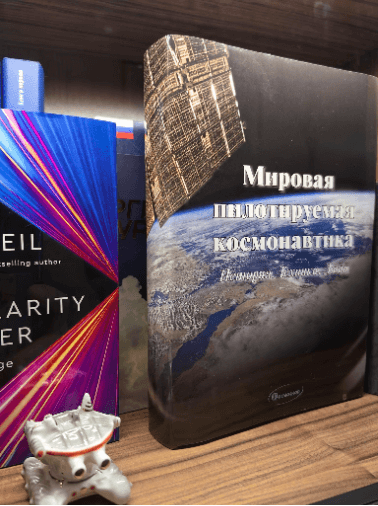
It inspired me to continue the historical description of manned cosmonautics in the 21st century. Now, a large team and I are creating a book with the working title “Human Spaceflight in the 21st Century. The Beginning.” This project is being worked on by cosmonautics enthusiasts and professionals from various fields — from space literature and journalism to 3D engineering and cosmonaut training.
Our book is a logical continuation of Baturin's work, combining encyclopedic accuracy with accessibility of presentation. We strive to make it interesting for a wide audience, while maintaining accuracy in detail. The publication will be supplemented with multimedia content accessible via QR codes, which will allow you to see additional photographs, video materials, 3D animations of technical systems and new chapters.
The book is scheduled to be published in early 2027, and I believe it will be an important contribution to the popularization of cosmonautics and the preservation of the historical heritage of the industry.
A good book about space not only broadens horizons, but also inspires, helps to realize the uniqueness of life and the importance of preserving our planet — the only known home in the Universe.
Pilot-Cosmonaut, Hero of Russia
Alexander Misurkin
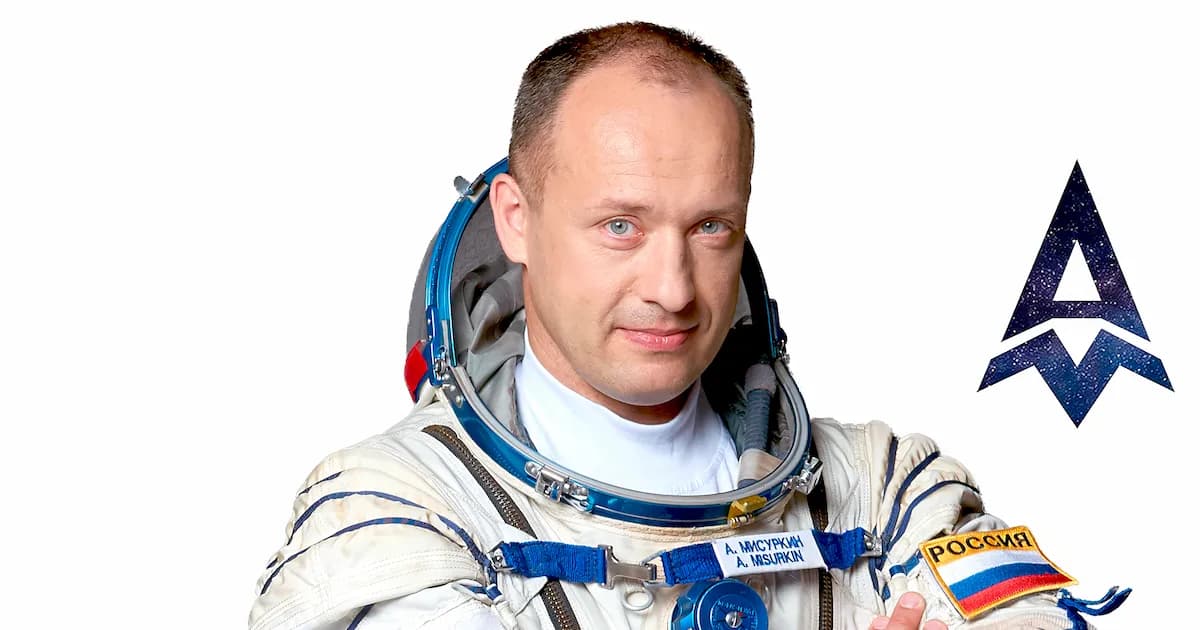
Hello! I'm cosmonaut Alexander Misurkin. My AI assistants Luke Vestin and "19-57" will answer your questions about space exploration and my experience.
To chat with Luke – simply type your question in the text field. If you're looking for space-related information from online sources, type "19-57, find information about ..." (it may take a moment – our robot is very thorough when searching the web).
Enjoy the conversation!