Trends in Modern Spaceflight: How the Technology and Science Behind Space Exploration Are Changing
13.10.2026The past decade has been one of the most dynamic in the entire history of spaceflight. In 2025 there were 315 successful orbital launches worldwide, almost four times as many as ten years earlier. Of those, 165 were flown by a single rocket, Falcon 9. About 4,500 spacecraft were placed in orbit that year; ten years ago the count was in the hundreds.

Launch Vehicles: Reusability Paid Off on the Second Attempt
The main technological shift of the decade is the recoverable rocket stage. The idea is not new: a partially reusable system was built back in the last century. The Space Shuttle brought its orbiter back, and its solid rocket boosters descended by parachute into the ocean, where ships retrieved them; only the external tank was expendable. And yet that transportation system remained the most expensive in history, and in 30 years it flew only 135 times.
A high flight rate was the plan back then too: the program was built around a fleet of five orbiters and 50 flights a year. It did not work out, for two reasons at once, and the first was technical. The orbiter turned out to be not an airplane but a machine that had to be taken apart after every flight: the two-week turnaround it was designed for became three to four months in practice, each of the 24,000 thermal protection tiles had to be inspected and hundreds had to be replaced, the three main engines were removed and overhauled, and the boosters recovered from the ocean were refurbished segment by segment. The second reason was the flow of payloads. The shuttle was designed as the country's only launch vehicle, but after the Challenger disaster commercial payloads were barred from it, and the military switched to expendable rockets. Instead of 50 launches a year, the average came to four and a half, and there was nothing to spread the fixed costs across.
What matters, it turned out, is the cost of servicing between flights and a steady supply of payloads. With Falcon 9, both came together: by July 2026 one booster had flown 36 times, and, at best, nine days passed between two flights of the same stage. The steady payload is something the company created for itself. The Starlink constellation has to be not only deployed but also maintained: the satellites are designed to work for several years and then have to be replaced, so the launches never stop.
In money terms, the gap looks like this. On the shuttle, a kilogram delivered to low Earth orbit cost about $14,000 if only the direct costs of a launch are counted, and up to $60,000 if the entire cost of the program, development included, is divided by the mass put into orbit. Today a place on Falcon 9 sells at a list price of about $3,000 per kilogram, and that is a price, not a cost: SpaceX's own costs for a launch on a reused booster are lower. In other words, we are deliberately giving the shuttle a head start in this comparison: for the shuttle we take the most favorable figure, for Falcon 9 the least favorable. Even so, the gap comes out at almost fivefold, and at twentyfold if the full cost of the program is counted.
Five systems can bring their stages back today, but they differ in maturity. Only Falcon 9 does it routinely; Falcon Heavy has been returning its side boosters since 2018 but flies rarely, since there are few payloads of that class. Starship's first stage has already been reused, while the second still splashes down. Blue Origin's New Glenn has landed its booster twice, but in May 2026 the rocket exploded during a static-fire test and damaged the launch complex. The fifth is China's Long March 10B: in July 2026 its stage made a high-precision approach and was caught by a net stretched above an offshore platform.
The next leap in cutting the cost of delivering cargo to orbit is expected from a new generation of super heavy-lift launch vehicles, but it has not happened yet.
Satellite Constellations: What a Single Satellite Cannot Do
After the rockets, the payload changed too: large, individually built satellites gave way to megaconstellations in low Earth orbit. Satellites built for practical purposes had worked as infrastructure before, too: the orbital segment of ground-based communications, weather and reconnaissance systems. What is new is something else. A constellation of hundreds or thousands of satellites provides continuous global coverage, which individual satellites could not, and services that used to be impossible are growing on top of it: broadband access anywhere, daily imaging of the entire land surface, seamless navigation, the Internet of Things.
The satellite, meanwhile, has stopped being a unique piece of hardware: the electronics have shrunk, assembly has moved to a production line, and components are no longer required to be ultra-reliable or to last for decades. A failed satellite is cheaper to replace with a new one. Such constellations leave orbit on the same mass scale on which they are deployed: low-thrust electric thrusters hold the satellites in formation and, at the end of a satellite's service life, bring it down. Cheap launch completed the chain, and from there sheer volume made production cheaper by another order of magnitude.
Starlink has more than 10,000 satellites today. China is deploying two constellations at once, Guowang and Qianfan, with stated goals of 13,000 and 15,000 satellites. In Russia, Bureau 1440 is building up its Rassvet constellation: the first commercial batch of satellites was launched in March 2026 and the second in July, with a target constellation of 292 satellites by 2030. The difference from the Chinese and American projects here is one of architecture, not of falling behind: the Russian satellites are larger and designed for a higher orbit, a stated 800 kilometers against roughly 550 for Starlink, although the satellites from the first launches are so far operating considerably lower and, according to independent observers, the target altitude may be revised. The higher the orbit, the fewer satellites are needed for continuous coverage. Amazon, too, is building a system of its own, Leo.
The clearest example of these new services is direct-to-device connectivity. Over the past two years the satellite has learned to talk directly to a smartphone, with no terminal, antenna or add-on box, working like an ordinary cell tower.
Orbit Is Being Divided Up
Orbital slots and radio frequencies are a finite resource, and it is allocated on the principle of "first to file and deploy." That is why Starlink, Guowang, Qianfan, IRIS² and Rassvet are not five competitors in a single market. Each of these systems is being built as a national asset, or in the case of IRIS² a pan-European one: places in orbit are being claimed the way territory once was.
The military turn has the same origin. The U.S. Space Force was made a separate branch of the armed forces back in 2019. But the real change came later, when commercial communications and observation constellations proved to be infrastructure on which the course of combat directly depends.
Over the decade, space has stopped being only a place people fly to and has become a place that is owned.
Two Economies of Robotic Exploration
Robotic probes were already exploring the solar system half a century ago, so their development is not a trend in itself. What has changed is the model by which they are built, but it has not changed everywhere.
The low-cost segment has gone through a revolution. Government agencies have moved from a "we develop the spacecraft and pay whatever it costs" model to a "we buy a service at a fixed price, and the risk is the contractor's" model: the agency names a price per kilogram on the lunar surface, and the contractor decides for itself how to meet it. The first commercial spacecraft to make a soft landing was Intuitive Machines' Odysseus in February 2024: it came down on a slope with residual sideways velocity, broke a landing leg and tipped over, but worked for about a week. The first fully successful landing was made by Firefly's Blue Ghost in March 2025.
The statistics are harsh, though: of seven commercial lunar missions, only one has been a complete success so far. The industry accepted this trade-off deliberately: a cheap spacecraft can be lost and the next one launched. The trade-off is possible precisely because there are no people on board: in a crewed program such arithmetic does not exist at all, and that is exactly why crewed programs move more slowly and cost more. Low cost, however, does not follow automatically from the commercial model: India's Chandrayaan-3 landed on the Moon in 2023 as part of an ordinary government program, for about $75 million.
In the high-cost segment, almost nothing has changed. A flagship science mission is still built by the government, costs billions and takes 10 to 15 years to develop. The reason is simple. It has proved possible to buy at a fixed price what someone has already done before: cargo delivery, a stream of similar images, atmospheric sounding data. But ordering a one-of-a-kind instrument for a fixed sum does not work: no one knows in advance what such work will cost, the contractor included.
The pressure on this segment is growing. The Mars Sample Return program, for example, was shut down not for technical reasons but because priorities were revised. The U.S. administration's request for 2026 would have cut NASA's budget by almost a quarter, to $18.8 billion, and its science programs by half; Congress rejected this and kept funding almost at the previous level, $24.4 billion. The Space Force requested $26.3 billion for the same year, and about $40 billion with additional appropriations.
Human Spaceflight: The Moon and National Stations
Humans have returned to the Moon. In April 2026 the Artemis II crew flew around it on a free-return trajectory, one from which the spacecraft comes back to Earth by itself even if its engine never fires again. It was the first crewed flight beyond low Earth orbit since 1972.
China plans to land its astronauts on the Moon before 2030. Next in the announced plans is the Chinese-Russian International Lunar Research Station, which about 15 other countries have joined, but in its basic configuration of the mid-2030s it is designed to operate without a crew: a permanent human presence has been put off to a later stage.
Human access to orbit has itself changed: fully private crews and commercial visiting missions have appeared. In 2024 the first spacewalk by the crew of a private mission took place, and in 2025 representatives of India, Poland and Hungary worked on the ISS; their predecessors had flown more than 40 years earlier, under the Soviet Interkosmos program.
With orbital stations, the picture is more complicated. Two facilities are permanently crewed: the ISS and China's Tiangong. Commercial stations were supposed to replace the ISS, and here it is plain to see how the plan keeps lurching. The launch of the first of them, Vast's Haven-1, has slipped to 2027. In March 2026 NASA proposed changing the architecture itself: the core of the station would remain government-owned, and private companies would attach their modules to it. The contractors that had been building stand-alone stations objected; by June the agency had gone back to the original plan, and in July it released a draft request for proposals: at least two companies will receive contracts for early development. The direction has thus been kept, but the architecture was revised twice in a single year, the schedule has slipped, and the main customer is still NASA itself: demand that could carry a station without it is not yet in sight.
The Russian Orbital Station is holding to its announced milestones, with the first module planned for no earlier than 2028 and the full configuration by 2034, but its shape has changed noticeably. In December 2025 the orbital inclination was changed from near-polar to 51.6 degrees, the same inclination the ISS flies at. A polar orbit would have given a view of the country's entire territory, but it would have taken the station through regions of elevated radiation: the station would have had to be either visited by crews rather than permanently crewed, or given extra shielding. The ISS inclination removes that problem, and it is also considerably cheaper, and not only because a launch from Baikonur puts more mass into such an orbit. The very format of the construction changes: in the same orbit, not everything has to be built anew. The operation of the Nauka module is being extended to the end of 2035, and the module is to become part of the Russian Orbital Station: the new station is being started not from a clean slate but from the Russian segment of the ISS, which is already flying. A political reason has been given as well: to keep the possibility of international cooperation open, since partners can reach such an orbit if they wish.
The main thing, though, is that no second project in which countries would work together, as on the ISS, is being built today. The Russian station is being created as a national one, Tiangong is national, in March 2026 NASA paused the lunar orbital station Gateway, and the lunar programs have split into two blocs.
The Atom Returns to Space
One direction has emerged just within the past year: the return of nuclear power to space. And it has not come back in the form that was expected.
For half a century the main hope was the nuclear thermal rocket engine: a reactor heats the propellant, the substance the engine expels, and accelerates it about twice as efficiently as chemical combustion, which means the same task takes half as much propellant. In 2025 the joint U.S. program to develop it was shut down, and the reason DARPA gave is telling. The whole point of such an engine was to save on the mass launched into orbit. And launching mass has become cheaper. Loading more propellant into a conventional rocket turned out to be simpler than perfecting a system with a reactor on board, which is complex and expensive in itself. The bet has shifted to nuclear electric propulsion, in which the reactor provides electricity and electric thrusters produce the thrust.
In March 2026 NASA, together with the Department of Energy, announced the development of the SR-1 Freedom spacecraft, with a reactor rated at about 20 kilowatts: launch at the end of 2028, arrival at Mars in 2029, and a payload of three Mars helicopters with ground-penetrating radar to search for subsurface ice. In Russia, work on a megawatt-class Transport and Energy Module has been under way since 2010: in April 2026 the conceptual design was completed and the project moved into engineering development, and space nuclear power itself was made a separate federal project running until 2036.
There is experience here, and most of it comes from our country. From 1970 to 1988 the USSR launched more than 30 spacecraft with nuclear power systems. Two of them, Cosmos 1818 and Cosmos 1867, launched in 1987, carried the TOPAZ thermionic reactor and plasma thrusters powered by it. That was the world's first working combination of a reactor and electric propulsion: on the American SNAP-10A of 1965 the reactor ran for 43 days and the ion thruster had to be switched off after less than an hour, whereas the TOPAZ reactors ran for 142 and 343 days, powering plasma thrusters, albeit at a power of only a few kilowatts. A megawatt-class system capable of propelling an interplanetary spacecraft has never yet flown.
The point of moving to nuclear electric propulsion is that it makes it possible to fly faster. A fast transit is possible with chemical engines too; the question is the price: their exhaust velocity is low, so every month gained requires several times more propellant, and the spacecraft simply becomes impossible to launch. Hence the reliance on economical trajectories, with a flight to Mars taking six months or more. Electric thrusters have an exhaust velocity roughly an order of magnitude higher: the same change in velocity costs several times less propellant, and a fast transit becomes feasible. The reactor is needed to give these thrusters electricity where solar panels are no longer enough.
Travel time means an accumulated radiation dose and a supply of consumables, and those are not an abstraction: water, oxygen, carbon dioxide absorbers, food, the service life of spacesuits and filters. Every extra month means tons of cargo that have to be accelerated along with the spacecraft, and an extra dose that nothing can offset.
A lunar base comes up against something else: power on the surface. Solar panels cannot cover 14 Earth days without the Sun, and so surface reactors of around 100 kilowatts have appeared in the plans.
Computing Moves to Orbit
More and more often, the computing has to be done right in orbit, for two reasons.
The first is the economics of data. An Earth-imaging satellite produces terabytes a day, and sending them down is expensive: it takes ground-station time, frequencies and onboard power. Yet what the customer usually needs is not the image itself but the answer it holds: how many ships are in port, where the ice has cleared, whether the edge of a logging area has moved. Onboard processing turns terabytes into kilobytes: where images used to be interpreted by hand on Earth, neural-network classifiers now work right on the satellite.
The second reason is external. Computing has run short of room on Earth: demand has come up against power grids, grid connection capacity and water for cooling. In orbit the Sun shines continuously and there is no grid to share with anyone, and the computing industry has gone to space of its own accord. The first free-flying demonstrator of an orbital data center has been operating there since November 2025, and Google and SpaceX have announced projects of their own.
There is enough energy in orbit; the bottleneck is heat: in a vacuum it leaves only by radiation, so the radiators end up larger than the spacecraft itself. The technology is not new, and liquid cooling loops have long been working on the ISS, but the scale is different, and it is the scale that defines what an orbital data center looks like. The task is essentially the same as for interplanetary flight: to obtain a lot of energy and get rid of the heat, in one case for the sake of speed, in the other for the sake of computing.
Conclusion
Spaceflight over the past decade has been moving in several directions at once. Access to orbit has become so much cheaper that a launch is now routine, and the next leap will come when fully reusable super heavy-lift launch vehicles enter service. Individually built satellites have given way to megaconstellations, on which global services have grown. Governments have changed their procurement model and let private companies into the industry. Humans have returned to the Moon, while orbital stations have gone their separate ways as national projects. Nuclear power has come back. The computing industry has come to space. And, as the reverse side of all of this, near-Earth space has turned into an object of ownership and rivalry.
Forecasts in spaceflight have rarely come true: a crewed mission to Mars has been promised "in 20 years" continuously since the early 1970s, and each time the count starts over; mass suborbital tourism was expected by the 2010s. The industry depends too heavily on decisions made outside it and on technologies that appear somewhere other than where they are being sought.
Still, one observation goes beyond this list. Beyond the atmosphere, I am convinced, humanity should act as a single civilization. The trend toward division, into national stations, competing lunar programs and sovereign orbital infrastructures, runs counter to this. Meanwhile, for a quarter of a century the ISS has been proving that working together in space is possible even when no agreement can be reached on Earth. This project brought different states and societies together, and it still does, in spite of everything. What is troubling is precisely that a process that had barely begun to take shape is being fragmented.
Humanity will become a true spacefaring civilization not when it learns to fly farther. This is a question not of technological development but of identity. What matters is who a person feels they are beyond the atmosphere. As long as a person there is above all a representative of a country, space remains an extension of earthly borders. We will become a spacefaring civilization on the day when not only crews in orbit but also most of those who make decisions on Earth feel that they are representatives of a single humanity.
Data as of July 29, 2026.
This text was written for VEB.RF City Labs and published in the “Opinions” section of the “City Labs on Trend” project.
Alexander Misurkin is a pilot-cosmonaut and keynote speaker.
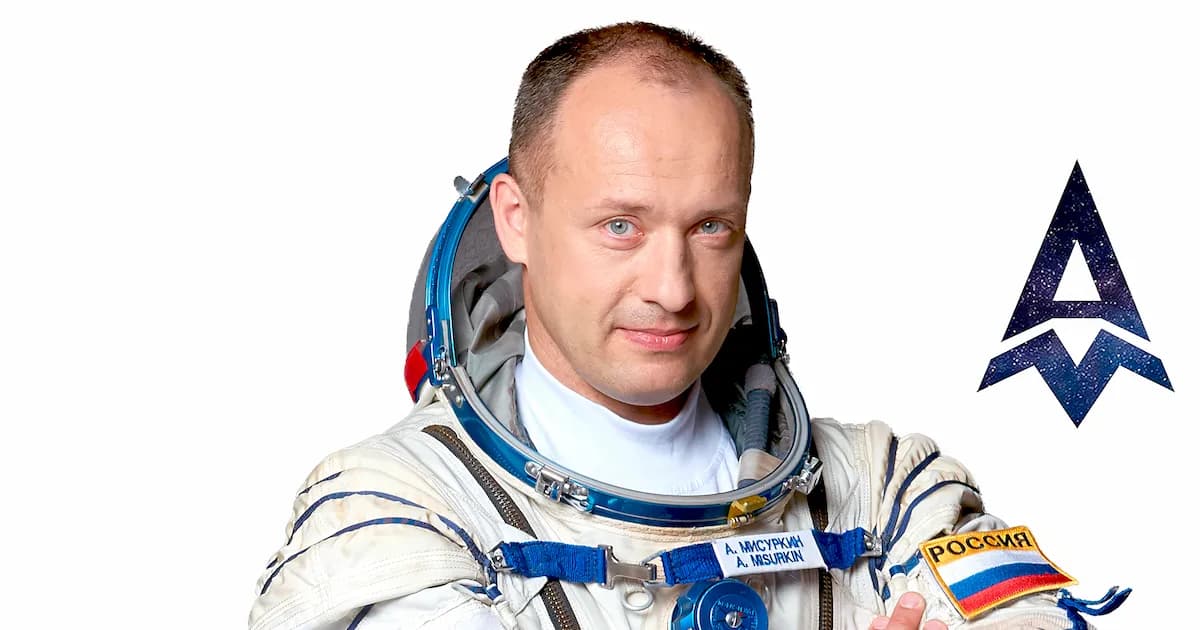
Hello! I'm cosmonaut Alexander Misurkin. My AI assistants Luke Vestin and "19-57" will answer your questions about space exploration and my experience.
To chat with Luke – simply type your question in the text field. If you're looking for space-related information from online sources, type "19-57, find information about ..." (it may take a moment – our robot is very thorough when searching the web).
Enjoy the conversation!